Vehicle Class
Sedan
$250–$600
Steel Rate Context: ~$0.10/lb
Light-to-mid sedans 2,700–3,300 lbs; Toyota Corolla, Honda Civic, Toyota Camry, Hyundai Elantra most commonly scrapped.
Scrap car prices in Ontario typically range from $250 to $600 for sedans and $400 to $1,200 for SUVs and trucks - based on 2026 Canadian market conditions, an Ontario steel rate of $0.10 per pound, and the GTA's position as Canada's highest-demand scrap car region.
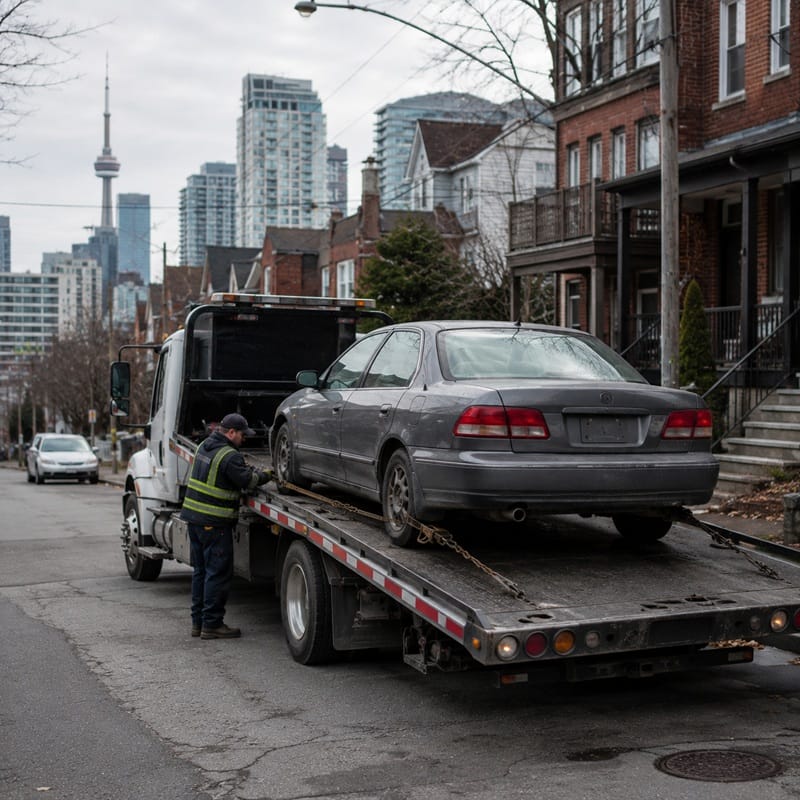
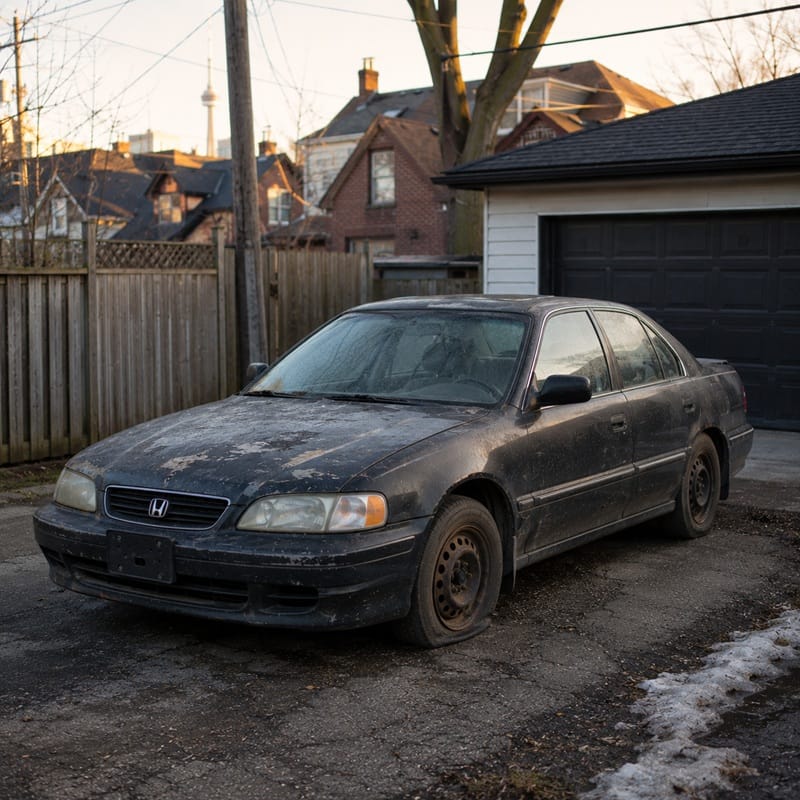
Scrap car prices in Ontario refer to the cash value paid for end-of-life, damaged, non-running, or recyclable vehicles - based on vehicle weight, reusable parts, local recycler demand, and current metal-market conditions.
Payouts in Ontario typically range from $250 to $600 for sedans and $400 to $1,200 for SUVs and trucks, based on 2026 market conditions and an Ontario steel rate of $0.10 per pound. Toronto and the GTA tend to deliver the strongest offers due to recycler competition - Ontario is Canada's highest-demand scrap car region.
Vehicles with intact catalytic converters can add $100–$500 to total value, often exceeding the standard ranges. This page explains general Ontario pricing trends and market conditions; the scrap car value calculator provides a vehicle-specific estimate based on your exact make, model, condition, and location.
$250–$600
Steel Rate Context: ~$0.10/lb
Light-to-mid sedans 2,700–3,300 lbs; Toyota Corolla, Honda Civic, Toyota Camry, Hyundai Elantra most commonly scrapped.
$400–$1,000
Steel Rate Context: ~$0.10/lb
3,300–4,000 lbs; Honda CR-V, Toyota RAV4, Ford Escape, Mazda CX-5 common.
$500–$1,200
Steel Rate Context: ~$0.10/lb
4,000–5,200 lbs; Ford F-150, Chevy Silverado, Ram 1500, Toyota Tacoma; heavy-truck retirements often command top of range.
$300–$700
Steel Rate Context: ~$0.10/lb
3,500–4,500 lbs; Dodge Grand Caravan, Chrysler Pacifica, Honda Odyssey, Toyota Sienna.
These ranges reflect Ontario's 2026 scrap metal market and the GTA-led demand premium. Ontario sits at the strongest end of Canadian provincial scrap car pricing - compared to $200–$500 sedans in BC and $200–$450 in Alberta - due to recycler density in the 416/905 corridor. The premium is structural rather than seasonal: more recyclers competing for inbound vehicles in a defined geographic radius compresses pickup logistics costs and increases what each recycler can offer at the curb. Vehicles outside the GTA may see slightly lower offers depending on partner-network routing, but the provincial range still applies. Catalytic converters add $100–$500 across all classes; junk cars with intact engines and high-demand parts can exceed the standard range, reaching the $5,000 ceiling for trucks with significant parts value. For a vehicle-specific Ontario estimate, the scrap and junk car value calculator produces an instant offer using your make, model, year, and condition.
Year Range: 2000–2012
National Range: $200–$400
Ontario Adjusted: $250–$450
Year Range: 2000–2012
National Range: $200–$450
Ontario Adjusted: $250–$500
Year Range: 2002–2012
National Range: $250–$500
Ontario Adjusted: $300–$550
Year Range: 2005–2015
National Range: $150–$350
Ontario Adjusted: $250–$400
Year Range: 2002–2012
National Range: $300–$600
Ontario Adjusted: $400–$700
Year Range: 2005–2015
National Range: $250–$550
Ontario Adjusted: $300–$600
Year Range: 2000–2015
National Range: $500–$1,200
Ontario Adjusted: $550–$1,200
Year Range: 2000–2015
National Range: $500–$1,500
Ontario Adjusted: $600–$1,500
Make and model affect Ontario scrap car value through three factors: vehicle weight (which determines base metal value at Ontario's $0.10/lb steel rate), parts demand (high-volume Ontario models like the Honda Civic and Toyota Corolla support stronger parts-buyer markets than lower-demand models), and catalytic converter type (precious metal content varies by manufacturer and engine size). Heavy-truck retirements common in Ontario's industrial and rural areas - Hamilton's steel-industry heritage, Oshawa's GM manufacturing context, Middlesex County agricultural areas around London - often deliver toward the top of the truck range due to intact parts and higher metal weight. For an Ontario-specific estimate by make and model, use the scrap and junk car value calculator.
Heavier vehicles contain more recyclable metal. An Ontario sedan at 2,800 lbs yields $280–$336 in base steel value at $0.10/lb. A 5,000 lb pickup truck yields $500–$600 in base metal alone before parts and catalytic converter premiums. Weight is the single largest factor across all Ontario scrap car pricing.
Running vehicles classify as junk cars rather than scrap-only and typically appraise 30–50% higher than non-running equivalents. A non-running Honda Civic might yield $250–$350 in Ontario; the same Civic running with an intact transmission could reach $400–$500 due to parts-buyer demand.
Catalytic converters contain platinum, palladium, and rhodium - adding $100–$500 to total Ontario value depending on vehicle make and converter type. SUVs and trucks typically have higher-value converters than compact sedans. Missing or stolen converters lower Ontario offers by the equivalent amount.
Ontario's 416/905 corridor has the highest scrap recycler density in Canada. Recycler competition for inbound vehicles in Toronto, Mississauga, Brampton, Vaughan, and Hamilton drives offers to the strongest end of provincial pricing - recyclers know any given vehicle has multiple buyers within a short drive, which raises the curbside offer at every step. Vehicles in outer Ontario may see offers 10–20% below GTA values due to transport distance and fewer competing buyers.
Ontario steel scrap trades at $0.10/lb on average as of 2026, against a national range of $0.08–$0.12/lb. Aluminum trades at $0.70–$0.90/lb. These rates shift through the year based on global demand and export markets; Ontario sits at the upper-mid range of provincial steel pricing alongside BC at $0.09/lb. Catalytic converter metals - platinum, palladium, and rhodium - trade independently of steel and can shift specific-vehicle offers outside the general steel cycle. Pickup logistics including fuel and transport costs also factor in, which is part of why GTA vehicles with shorter haul distances command stronger pricing.
Ontario scrap car prices vary most heavily between dense GTA markets with strong recycler competition and lower-density regional areas where travel distance and recycler availability affect pickup economics.
Toronto and the 416/905 corridor deliver Ontario's strongest scrap car offers. Cities including Mississauga, Brampton, Vaughan, Markham, and Richmond Hill all benefit from the same GTA recycler-density premium. Hamilton (Greater Hamilton anchor with steel-industry heritage) and Oshawa (Durham Region with GM manufacturing context) also support strong-end-of-range pricing. For full Toronto coverage including same-day pickup logistics and city-specific FAQ, see cash for cars in Toronto, ON.
Ottawa (Eastern Ontario, National Capital Region) and London (Southwestern Ontario, Middlesex County) operate within their own partner-network zones rather than the GTA recycler corridor. Both cities support Ontario provincial-range pricing, with response windows differing from same-day GTA standards. Outer Ontario - Northern Ontario, Eastern Ontario beyond Ottawa, far-Southwestern beyond London - is partner-network dependent and may see offers slightly below GTA premium values. The practical reading: Ontario vehicle owners deciding between scrapping locally and trailering to the GTA should weigh the 10–20% pricing gap against transport cost - for most sedans the geography rarely justifies the haul; for heavy trucks with parts value the math can shift. For broader provincial coverage and the full Ontario service map, the Ontario provincial hub is the starting point.
Receiving the Ontario prices outlined above requires the standard provincial paperwork.
Ontario license plates are linked to the owner, not the vehicle. When you scrap a vehicle in Ontario, you keep your plates to use on the next vehicle. If no longer needed, surrender at any ServiceOntario location.
Bring the green vehicle ownership permit to pickup. Detach the plate portion (top - yours) before pickup; sign the vehicle portion (bottom) as transferring ownership at pickup. The partner network handles buyer-side paperwork.
Cancel your insurance with your provider before or after pickup - Cash For Cars does not handle insurance settlements or refunds. Ontario's Drive Clean Program ended for passenger vehicles in April 2019, so emissions testing is not required for typical passenger scrap car sales. Heavy commercial vehicles fall under a separate emissions program. For broader Ontario service details, see the Ontario provincial hub.
The prices in this guide reflect typical Ontario ranges by vehicle class. For your specific vehicle's value - adjusted for actual weight, condition, intact components, and your specific Ontario city - estimate your Ontario vehicle's scrap value using the calculator. Cash For Cars covers all of Ontario with free pickup and cash on collection.